
Criminal Court Records in Delaware County
A criminal court record is the official case file the Delaware County Court Clerk opens once charges are filed. It is not the same as an arrest record. An arrest happens on the street, but the court record begins when the prosecutor files a charging document called an information and a case number is assigned. From that point the Court Clerk records, files, and keeps every entry in the case. The office maintains the appearance docket, the plaintiff and defendant docket, and the journal docket, and it works with the Civil, Criminal, Probate, Juvenile, Domestic Relations, and Small Claims divisions of the District Court.
Criminal cases in the county are heard in the Delaware County District Court, the general trial court for felonies and misdemeanors alike. Felony files carry the prefix CF and misdemeanor files carry CM. Charges are brought by District Attorney District 13, which covers Delaware and Ottawa counties under District Attorney Douglas S. Pewitt. When a defendant appeals a conviction, the appeal does not go to a county court at all. It goes to the Oklahoma Court of Criminal Appeals, the state court of last resort for criminal matters. A closer look at the charges themselves lives in the Delaware County arrest records and court charges.
The office that decides what to charge is profiled on the state District Attorney District 13 page.
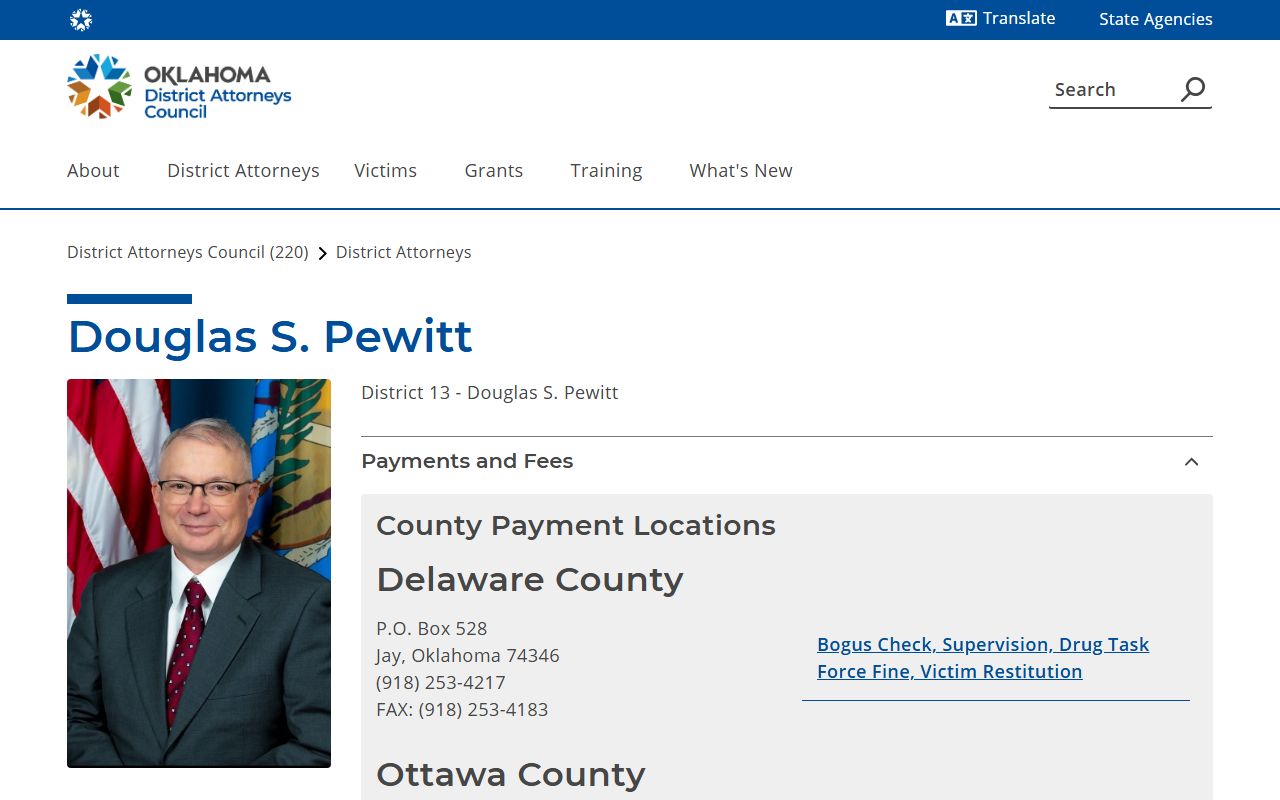
That filing decision is what turns an arrest into the criminal court record the clerk then maintains for the life of the case.
How to Search Delaware County Criminal Court Records
Most Delaware County criminal court records are searched through On Demand Court Records, the ODCR portal the Court Clerk links as its court-record search. ODCR covers participating Oklahoma District Courts, and Delaware County is one of them. The search is free for the public, though printing, case monitoring, and some account features may carry a fee.
- Open the ODCR search page and set the court group to Oklahoma District Courts.
- Choose Delaware as the court so results do not pull from other counties.
- Search by defendant name in Last, First format, or enter a full case number such as CF-2013-00310A.
- Narrow by case type, choosing Criminal Felony Proceedings or Criminal Misdemeanor Proceedings, and add a filed-date range when a name is common.
- Open a result to read the case information, charges, docket entries, and disposition, then request a certified copy from the Court Clerk if you need one for court.
The online file is convenient but not the final word. Under OCCA Rule 2.6, the OSCN and ODCR systems provide public online access, yet the court relies on its own case-management record when the two disagree. If a record looks incomplete, missing, sealed, or out of date, call the Court Clerk at 918-253-4420 or visit the office at 327 S 5th Street in Jay. The wider set of county filings beyond criminal matters can be reached through the broader collection of Delaware County court records.
Stages of a Delaware County Criminal Case
A criminal case moves through a set order, and each step leaves its own mark in the file. Charges are filed first. The defendant is then arraigned, enters pleas, and the case moves through pretrial motions toward either a plea agreement or a trial. The outcome is the disposition, and a sentence follows any conviction. Reading the docket in that order makes a long case easy to follow.
Case flow: Charges Filed › Arraignment › Pretrial / Motions › Plea or Trial › Disposition › Sentencing
| Stage | What Happens |
|---|---|
| Arraignment | The defendant is told the charges and enters an initial plea such as guilty, not guilty, or nolo contendere. Bond is often set here. |
| Pretrial / Motions | Lawyers file motions, exchange evidence, and may negotiate. The docket fills with continuances, orders, and hearing dates. |
| Plea or Trial | Most cases end in a plea. Others go to trial before a judge or jury, and the result is logged as the verdict or accepted plea. |
| Sentencing | After a guilty or nolo plea or a guilty verdict, the judge imposes a sentence: a fine, jail or prison time, probation, or a deferred or suspended sentence. |
What a Delaware County Criminal Court Record Shows
Once a Delaware County criminal file is open, its layout stays consistent. The case information block sits at the top, the charges and parties follow, and the docket entries and receipts run underneath. The samples published for the county show the same fields case after case, which makes a felony file and a misdemeanor file read much the same way.
| Field | What It Shows |
|---|---|
| Case Number | County code, a prefix such as CF or CM, the filing year, and a sequence number, for example CF-2013-00310A. |
| Defendant | The accused person's name and city, listed opposite the State of Oklahoma as the charging party. |
| Charges | The offense or cause, with the statute and a short description of each count filed. |
| Parties | The district attorney, defense or OIDS-appointed counsel, the arresting officer, the agency, and the assigned judge. |
| Plea | The defendant's formal response to each charge, entered as guilty, not guilty, or nolo contendere. |
| Bonds and Warrants | Bond amounts, appearance or personal recognizance bonds, and any bench warrant issued to the sheriff. |
| Disposition | The current or final outcome of each count, such as convicted, dismissed, or deferred. |
| Sentence | The punishment imposed after a conviction or plea, including fines, costs, custody, or probation terms. |
Fee lines round out the file, listing court costs, the sheriff arrest fee, the CLEET assessment, the law library fee, and similar charges tied to the case.
Reading Delaware County Dispositions and Sentences
The disposition is the heart of a criminal record because it states how each charge ended. A guilty or nolo finding becomes a conviction. A dismissal or acquittal means there was no conviction on that count. Oklahoma also uses deferred and suspended sentences, and the difference between them matters when reading the file.
- Disposition
- The final or current outcome of a charge or the whole case.
- Nolo contendere
- A no-contest plea that is treated like a guilty plea for sentencing.
- Deferred sentence
- Judgment is delayed while the defendant completes conditions, and charges can be dismissed if those conditions are met.
- Suspended sentence
- A sentence is imposed but not served as long as the defendant follows the court's terms.
- Revocation
- The court cancels a suspended sentence after a violation and orders the original time served.
- Acceleration
- The court moves a deferred case to judgment after a violation, often noted as an MTA in the docket.
Entries such as a motion to revoke, a motion to accelerate, or a judgment and sentence on revocation show a case that reopened after the first disposition.
Charges vs. Convictions
A charge and a conviction are not the same thing, and treating them as equal is the most common mistake people make when reading a criminal file. A charge is only an accusation. A conviction means the case was proven or admitted. A Delaware County criminal record can list charges that were later reduced, dropped, dismissed, or that ended in an acquittal, and the disposition column is what tells the two apart.
| Charge | Conviction | |
|---|---|---|
| Stage | Accusation | Verdict or plea |
| Burden of Proof | Probable cause | Beyond reasonable doubt |
| Public Record | Yes | Yes |
Note: A pending charge with no disposition yet is not proof of guilt, so always read the most recent docket entry before drawing a conclusion.
Appointed Counsel and Drug Court in Delaware County
Two features show up often in Delaware County criminal files and confuse first-time readers. The first is appointed counsel. When a defendant cannot afford a lawyer, the court appoints one through the Oklahoma Indigent Defense System, and the docket records it with an application for a court-appointed attorney, an OIDS notice, and a notice of assignment of counsel. OIDS is meant to provide representation comparable to what a paying client would receive.
The second is Drug Court. Delaware County runs a problem-solving Drug Court for qualifying cases, and the docket shows it through a plea agreement that places the defendant in a supervision phase, with sentencing held until the program is finished. A file may also carry an application for removal from drug court when participation ends early. These entries explain why some criminal cases stay open for years before a final disposition appears. Common docket markers for these tracks include:
- Application for a court-appointed attorney
- OIDS notice and notice of assignment of counsel
- Drug court plea agreement, supervision phase
- Application for removal from drug court
- Judgment and sentence entered after program completion
Sealed vs. Expunged Records
Some criminal records are removed from public view. Oklahoma draws a line between sealing and expungement, and the two are not interchangeable. A sealed record still exists but is hidden from ordinary public searches. An expunged record is treated as though it never happened, with the underlying files restricted far more tightly. Eligibility for both runs through state law rather than a clerk's discretion.
| Sealed | Expunged | |
|---|---|---|
| Visibility | Hidden from public | Treated as if it never existed |
| Law Enforcement | Limited access | Very limited access |
| Eligibility | Set by 22 O.S. § 18 categories | Court order under 22 O.S. § 18; OSBI cannot pre-approve |
The state explains those limits on its OSBI criminal-history expungement page.
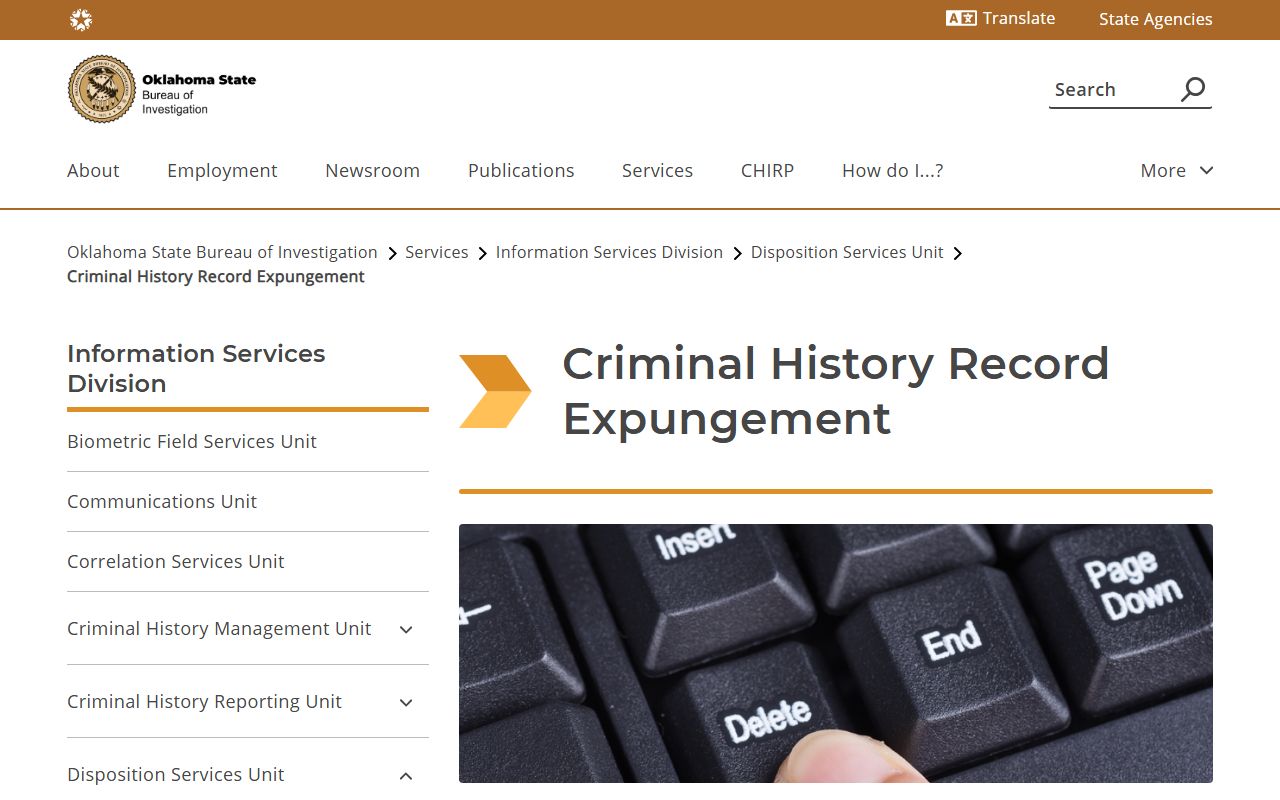
The page is clear that OSBI cannot tell anyone in advance whether they qualify, because eligibility is decided by the court under the statute.
Public Access to Delaware County Criminal Records
Criminal court files are open records in Oklahoma. The Oklahoma Open Records Act treats the records of public bodies as available for inspection and copying during business hours unless a specific exception applies. For court files, the practical route is ODCR first and the Court Clerk second, since the clerk is the official custodian of District Court records.
The rule that governs the public online system is published on the OCCA Rule 2.6 page.
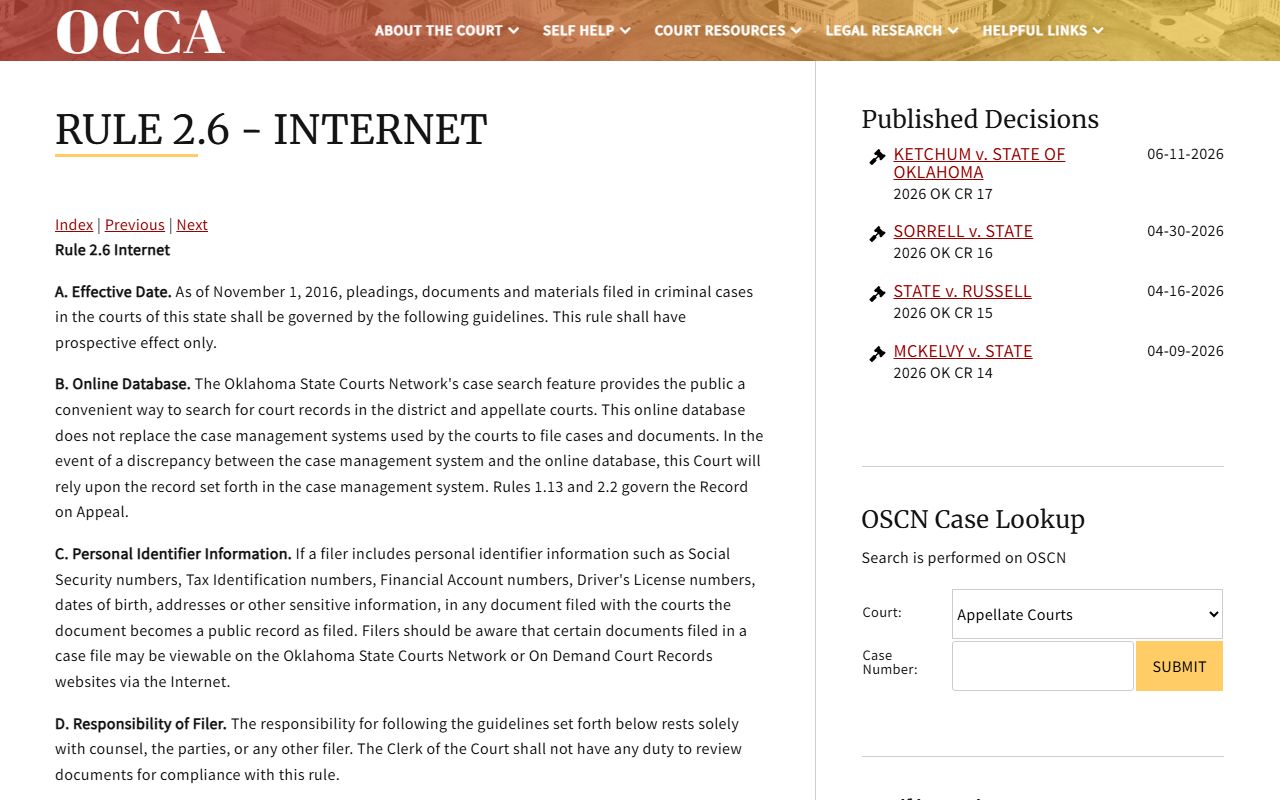
It confirms that online access is a convenience, not a replacement for the court's own case-management record.
Key Statutes:
Oklahoma Open Records Act, 51 O.S. § 24A.1 et seq. - Oklahoma's public-records law opens the records of public bodies unless an exception applies.
Oklahoma Statutes, 51 O.S. § 24A.5 - Public records are open for inspection and copying during regular business hours, with confidential-record exceptions.
Delaware County Criminal Records and Background Checks
A casual record lookup and a formal background check are not the same. A name search on ODCR shows what a single county's court files contain. A regulated background check pulls from many sources and is governed by federal rules when used for hiring, housing, or credit. For a statewide criminal-history check, the Oklahoma State Bureau of Investigation is the proper source rather than a county court search.
Important: This website is not a consumer reporting agency under the Fair Credit Reporting Act, and its information may not be used for employment, tenant, credit, or insurance screening.
Restricted Criminal Court Records in Delaware County
Not every criminal case is open to the public. Juvenile and youthful offender matters are handled differently from adult cases and are generally not treated as ordinary public records. Sealed and expunged files drop out of public search once a court order is entered. Some documents inside an otherwise public case may be redacted to protect personal identifiers, victims, or minors, and certain law-enforcement reports are released only by subpoena.
The categories of people who may ask a court to clear a record are set out in the official Oklahoma expungement statute, 22 O.S. § 18.
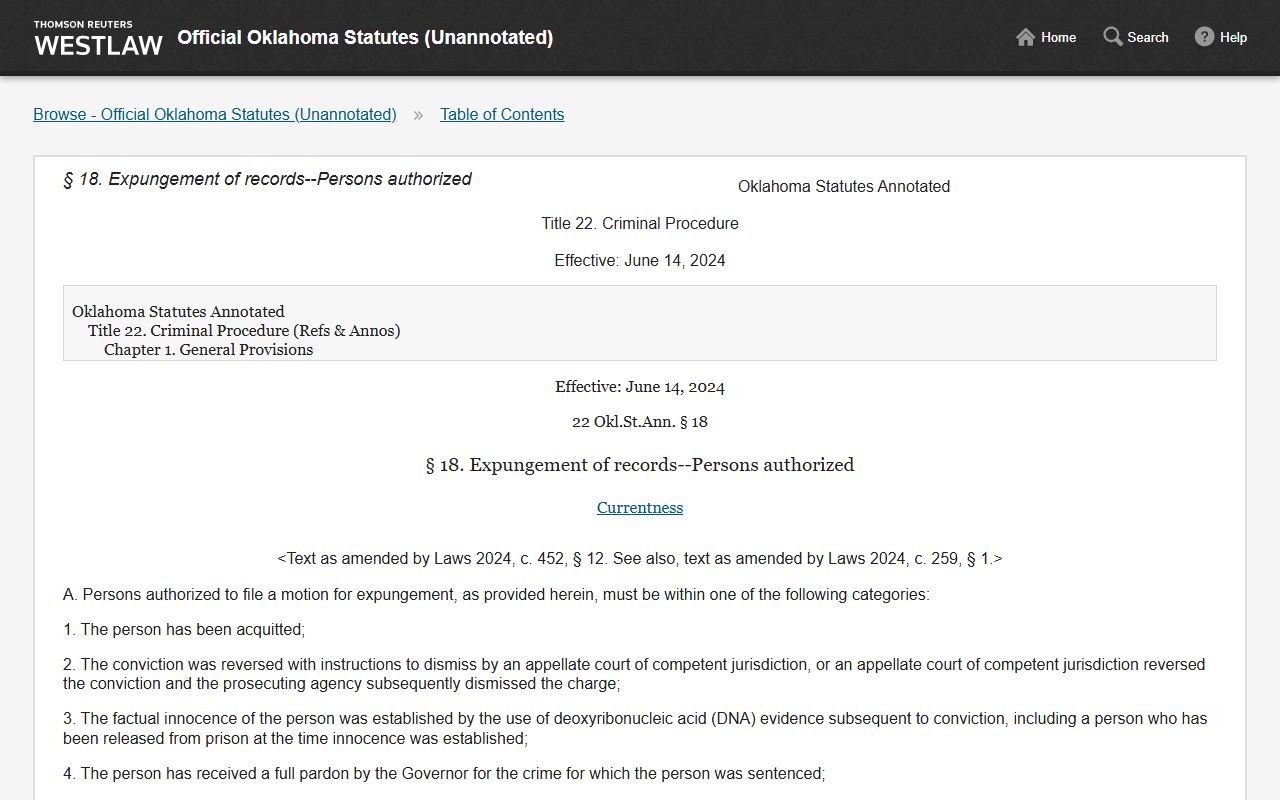
Because eligibility is narrow and procedural, the Court Clerk or a licensed attorney is the right starting point for anyone weighing an expungement in Delaware County. Older case files may also need a direct call to the clerk, since not every scanned document from earlier years appears in the online index.