
What Probate Covers in Delaware County
Probate is the court process for settling what a person owned and owed after death. In Delaware County it also reaches guardianships for minors and incapacitated adults, conservatorships over a person's finances, trust disputes, and the formal filing of wills. A case opens when someone asks the court to admit a will, name a personal representative, or appoint a guardian. The court then supervises the estate until debts are paid and the property left over passes to the heirs or named beneficiaries.
Delaware County does not have a stand alone probate court. Probate is a division of the Delaware County District Court, the same trial court that hears civil and criminal cases at the courthouse in Jay. The Court Clerk records, files, and keeps the permanent papers for every probate matter, working alongside the Civil, Criminal, Juvenile, and Domestic Relations divisions. The judge who signs a probate order sits in the District Court. The physical case file and any certified copies come from the Court Clerk's office.
Probate Terms Defined
Probate paperwork leans on a handful of legal terms that show up again and again. A short reference makes the filings easier to read before a search begins.
- Testator
- The person who made the will. When that person dies, the will is offered to the court for probate.
- Executor
- The person named in the will to carry out its terms, gather the assets, pay debts, and distribute what remains. The court issues letters testamentary to confirm the role.
- Intestate
- Dying without a valid will. The estate is then divided under Oklahoma's intestate succession rules rather than by a written document.
- Guardianship
- A court arrangement giving one person legal authority over the care and decisions of a minor or an incapacitated adult.
- Conservatorship
- A court appointment to manage the money and property of someone who cannot handle their own financial affairs.
How to Search Delaware County Probate Records
The starting point is On Demand Court Records, the public portal the Court Clerk links as its court search. The ODCR search page covers participating Oklahoma district courts, and Delaware County is listed. The basic case search is free. Some printing, monitoring, or paid features may ask for an account. The online index is convenient, but it does not replace the court's own case management system, so an unclear or missing record should always be confirmed with the Court Clerk.
A clean search runs in a few steps.
- Open the ODCR search page and set the court group to Oklahoma District Courts.
- Choose Delaware as the court so results stay inside the county.
- Enter the party name in Last, First format, or type the full case number if you already have it.
- Narrow by type of case, such as Probate Proceedings or Guardianships, when the category is known.
- Add a filed date range for older estates, where a name search alone returns too many results.
- Open a result to view the case information, parties, docket entries, and any fees on record.
The portal exposes the following fields for a probate search.
| Field Label | Type | Required | Options / Format Notes |
|---|---|---|---|
| Court | dropdown | recommended | Delaware |
| Party name | text | optional | Last, First or an estate-related party |
| Type of case | dropdown | recommended | Probate Proceedings, Probate Miscellaneous Proceedings, Guardianships, Conservatorship, Trust Proceedings, Filing of Wills |
| Full case number | text | optional | Use the probate prefix if known |
| Filed date range | date fields | optional | Useful for older estate searches |
| Activity date | date field | optional | Useful for recent docket events |
Delaware County Probate Case Types
ODCR sorts probate work into several case categories, and picking the right one keeps a search focused. The categories reflect the different jobs the Probate Division handles, from settling a full estate to overseeing a single trust.
- Probate Proceedings, the main category for administering a decedent's estate.
- Probate Miscellaneous Proceedings, for related filings that fall outside a standard estate.
- Guardianships, covering minors and incapacitated adults.
- Conservatorship, for management of a protected person's property.
- Trust Proceedings, where a trust is administered or contested.
- Filing of Wills, for wills lodged with the court.
A case number prefix often signals the category in the docket. When the type is uncertain, a name search across all categories will still surface the matching file.
Where Delaware County Probate Cases Are Filed
New estates, guardianships, and will filings go to the Delaware County District Court through the Court Clerk, not the County Clerk. The Court Clerk maintains the appearance docket, the journal docket, and the permanent file for each case. Certified probate orders and letters of appointment are issued from this office, and staff can confirm the status of an older file that may not be fully indexed online. The same office keeps the county's marriage and divorce records, so one counter handles several family-related record types.
Delaware County Court Clerk / District Court
327 S 5th St
Jay, OK 74346
Mailing: PO Box 407, Jay, OK 74346
918-253-4420
Fax: 918-253-5739
delawareclerk@oscn.net
Hours: 8:00 to 4:30
For a full profile of the office and its request methods, see the Delaware County Court Clerk page.
Fees for Delaware County Probate Instruments
Delaware County does not publish a set probate filing or copy fee online, so the amount charged at the Court Clerk should be confirmed by phone before a filing or records trip. A separate set of fees applies when a probate result is recorded into the county's land records. When a deed, will, or other probate instrument is filed with the County Clerk to update property ownership, the standard recording fee schedule below takes effect.
| Item | Amount |
|---|---|
| Standard document, first page | $18.00 |
| Standard document, each additional page | $2.00 |
| Nonconforming document, first page | $35.00 |
| Nonconforming document, each additional page | $10.00 |
| Photographic copy, per page | $1.00 |
| Certification to a copy, per page | $1.00 |
| Preservation fee, per document | $10.00 |
Note: Confirm the probate filing and copy fees directly with the Delaware County Court Clerk at 918-253-4420, since those amounts are not posted online.
What Delaware County Probate Records Show
A probate file builds in layers as the estate moves forward. Early documents open the case and name who will run it, while later filings track the property and close out the distribution. The papers most often found in a Delaware County estate file include several standard items.
- Petition to admit a will or petition for administration.
- Letters testamentary or letters of administration naming the personal representative.
- Inventory and appraisement of the estate's property.
- Creditor notices and orders on claims against the estate.
- Orders for the sale of real estate when property must be sold.
- Final account and the decree of distribution that closes the case.
Guardianship and conservatorship files add their own records, including the order of appointment and the periodic guardian or conservator reports the court requires.
Probate Records in Delaware County Land Records
Probate frequently changes who owns real property, so part of the trail lives with the County Clerk instead of the Court Clerk. When an estate transfers land, the recorded instrument appears in the county land records and can be pulled through the OKCountyRecords Delaware search. Indexed images there reach back many decades, and new recordings post in real time.
Instrument types that cross from a probate case into land records include Probate, Will, Trustee Deed, Executors Deed, Administrators Deed, and Transfer On Death. The court file at the Court Clerk holds the proceeding itself, while the County Clerk holds the recorded deed that proves the new ownership. For a certified court order or letters, request the Court Clerk. For a recorded land instrument, request the County Clerk.
Oklahoma Courts and Probate Appeals
Probate is a civil matter, so a final order from the Delaware County District Court follows Oklahoma's civil appeal path. The Oklahoma Supreme Court is the civil court of last resort and may assign a case to the Court of Civil Appeals. The state posts recent rulings and court information on the official Oklahoma Supreme Court website.
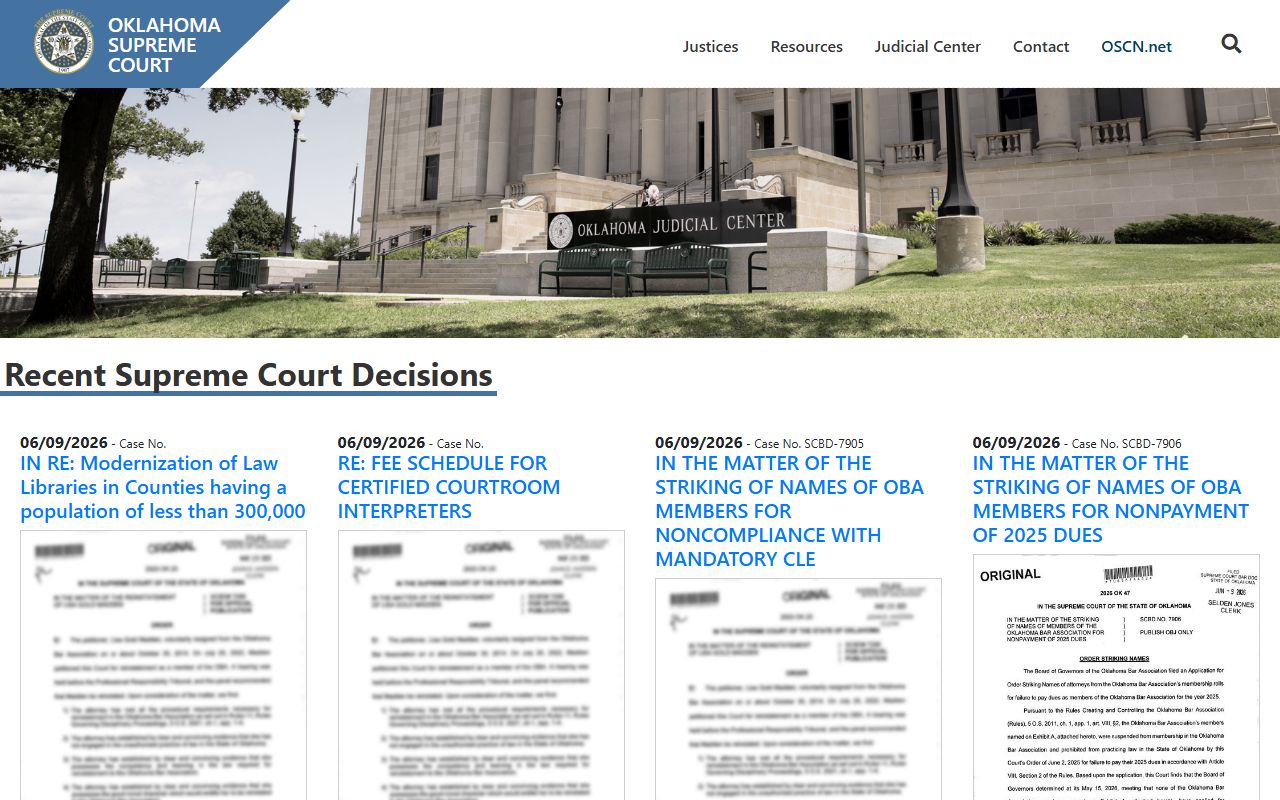
That court sits at the top of the same judicial system that supervises Delaware County probate records, which keeps appellate decisions and trial court practice aligned. Most estates never reach this level. Knowing the path still helps when an heir or creditor contests a probate ruling and wants to understand where a challenge would go.
Restricted Delaware County Probate Records
Probate files are largely open, but parts of them can be limited. Public access narrows where a guardianship involves a minor, where medical incapacity is described, where financial account numbers appear, or where a judge has sealed a filing. Conservatorship and guardianship records carry the most sensitive personal detail, so some pages may be redacted or withheld.
Older estates can be harder to pull online. The court's electronic index may not contain every scanned page from a file opened years ago, which means a direct request to the Court Clerk is often the fastest route to a complete copy. Staff can locate the paper file by case number or by the name of the person who died.
Note: A sealed or guardianship-related probate file may require a court order or a showing of legal interest before the Court Clerk can release the full record.